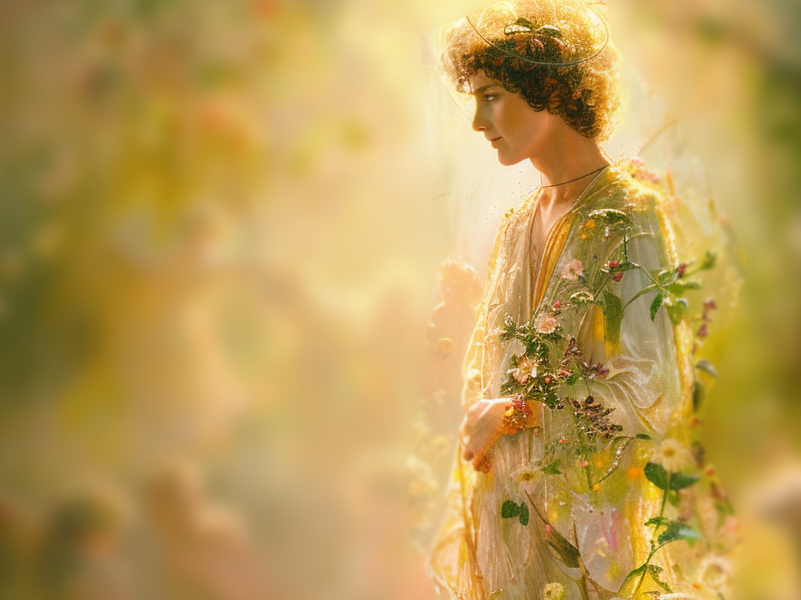
 Forbidden Archive Entry: Astamos, The Gentle Flame
Book: The Quiet Wars of Heaven, Volume II: Of Love, Exile, and the Shape of Mercy
Recovered From: A sealed root-vault beneath the Oltho Forest, bound in barkstone and sung open by the last Masdeian monks
Attributed Author: Caelreth of the Soft Quill, Chronicler of Bontar
Status: Contested, Sacred, Restricted to Senior Archivists and Dream-Readers
 Entry Begins
Astamos is remembered as the gentle brother. This is both truth and convenient lie.
Where Klarian broke the world to understand it, and Galbraith measured it to preserve it, Astamos chose to feel it. He is the Quoni of Love, Growth, Dream, and the quiet persistence of life that returns even after ruin. The old towers teach that he is peace given form. The deeper records say something more dangerous: that Astamos is longing made divine.
When Jokhan and Athina cast their sons into Klintorth to learn restraint, Astamos did not rage. He wandered. His lands in the north, Merjaltu, Bontar, Montar, the Oltho Forest, and the Islands of Qhalanjir, became places of shelter and soft power. Rivers bent instead of breaking. Forests grew thick enough to hide whole peoples. The air itself learned patience there.
It is written that Astamos cannot bear to see creation suffer, yet he cannot stop suffering without unmaking choice. This is his eternal wound. He heals, but never erases. He dreams, but never commands.
 From his essence came Kaitlyn, Goddess of Love, Purity, and Vanity, a reflection of his desire to see beauty in what he made. From his bond with Trinity came Nathaniel, and through her union with Masdeio, the Elementals, beings whose emotions move the weather, the fire, the sea, and the sky itself. Astamos wept when he realized his children could unbalance the world as easily as they could preserve it.
Unlike Klarian, Astamos does not seek dominion. Unlike Galbraith, he does not seek order. He seeks connection. This is why cult and temple alike struggle to define him. He appears not in crowns or thrones, but in moments: a hand on a dying brow, a dream of warmth in a frozen night, a flower growing through stone.
Yet even the gentle Quoni can be terrible when pushed too far.
In the oldest songs of the Kingswood, it is said that when Astamos truly rages, the world does not burn.
It blooms.
Forests swallow cities. Roots split walls. Vines climb towers and choke banners into silence. War ends not with screams, but with green.
 His followers call this mercy. His enemies call it erasure.
Perhaps both are correct.
Closing Note of the Author
If you read this seeking a savior, you will be disappointed.
If you read this seeking a tyrant, you will be confused.
Astamos is neither.
He is the part of the world that still believes you can be better, even when you prove, again and again, that you do not wish to be.
— Caelreth of the Soft Quill,
who dreamed of a garden and woke in a war.